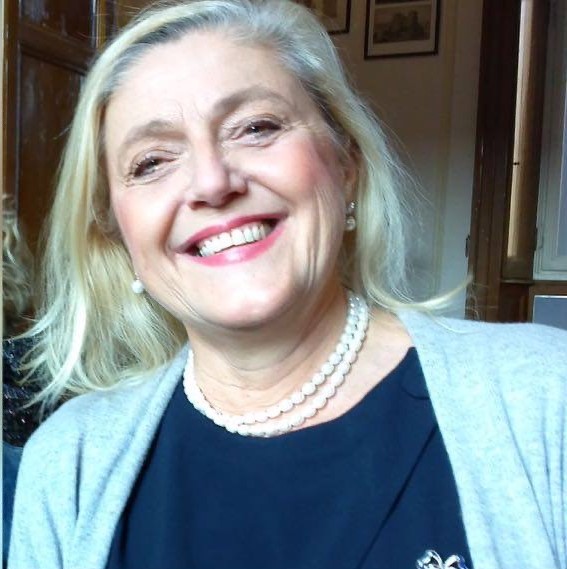
"See the potential, remove the barrier, let her lead."
What is your personal motivation for serving on the SIE Board 2026-2027?
My decision to join the SMLA Committee grew from my experience as club president and National Programme Director for Soroptimist International d’Italia. After years of working at local and national level, I felt the need to broaden my perspective, because meaningful change for women requires not just local commitment, but European solidarity.
International relationships and a passion for other cultures have always been part of my life. I hold a degree in modern languages, and throughout my career as a teacher I consistently encouraged my students to pursue European projects and exchanges. All of this has given me, I believe, a natural openness to cross-border collaboration and a deep conviction that the most meaningful change is built together, across borders.
Managing the scholarship portfolio feels particularly close to who I am. Supporting talented young women at a pivotal moment in their lives, removing the financial barrier between ambition and opportunity, is one of the most direct expressions of what Soroptimist is for.
That is why I am here: because excellence, multiplied across borders, becomes transformation.
What is your vision for a better world?
A better world, to me, is one where every woman has equal access to education, economic opportunity, and safety, and where a woman’s potential is never diminished by the simple fact of who she is.
What has convinced me that this world is possible is what I have seen directly through reviewing scholarship applications. The women whose files I have read were not lacking in talent, ambition or determination. They were exceptional, in their fields, in their commitment, in their vision for the future. What they needed was simply the financial means to go further. And once that barrier was removed, they did not just advance professionally, they became a resource for other women, multiplying the impact of a single investment many times over.
This is what Soroptimist does at its best: it does not rescue women. It removes the one obstacle standing between an exceptional woman and the future she has already earned.
For this biennium, my aims are concrete: to strengthen the scholarship process so that it reaches the most deserving candidates across Europe, to build a pathway that continues through mentoring and leadership, and to make our impact measurable and visible.
A better world begins when every woman has not just the right, but the real conditions to lead. But it also begins with each of us. No meaningful change happens without collective responsibility, and that, at its deepest, is what it means to be a Soroptimist: to recognise that the world we want for others is one we must actively build ourselves, together.
What do you do to stay motivated in your work?
Paradoxically, it is often the difficulty itself that motivates me most. When I encounter an obstacle, something in me refuses to accept it, I find myself pushing harder, looking for a way through rather than around.
But beyond my own nature, there is a deeper reason I keep going. When I think of the millions of women who still live with gender inequality as a daily reality, I think of my three-year-old granddaughter. I do not want her to face, as an adult, the same barriers that women face today. That thought is more motivating than any professional goal.
When challenges arise, my approach is deliberate: I stop, review what I have done, ask my teammates for honest feedback, and change course if necessary.
I have also been fortunate. Throughout my Soroptimist journey I have always been surrounded by colleagues who supported and encouraged me and I try to offer the same to the people I work with.
What is your country doing to support and empower women?
Italy has built a substantial legislative framework for gender equality, one that addresses health, safety and economic participation in concrete, enforceable terms.
In the field of gender medicine, Italy was the first country in the world to enshrine a gender-specific approach within its national health system. Law 3/2018 mandates the application of a sex and gender lens across all clinical practice, from prevention to diagnosis and treatment, while the National Reference Centre for Gender Medicine at the ISS coordinates its implementation nationally.
On violence against women, the Codice Rosso — Law 69/2019, established an accelerated judicial response to gender-based violence, requiring prosecutors to hear victims within three days of a complaint. In December 2025, Law 181/2025 went further still, introducing femicide as a standalone criminal offence carrying automatic life imprisonment. Italy has also established a permanent Parliamentary Committee on Femicide (Commissione Parlamentare di Inchiesta sul Femminicidio), which monitors the implementation of anti-violence laws and regularly reports to Parliament — one of the few such dedicated oversight bodies in Europe.
On workplace equality, Law 162/2021 introduced mandatory Gender Equality Certification for companies above fifty employees, tied to tangible fiscal incentives, while corporate gender quotas ensure minimum female representation on the boards of listed companies and in public administration.
Legislation, however, is only the beginning. Organisations like Soroptimist carry the indispensable responsibility of ensuring that what is written into law is felt in the daily lives of women across the country.
Tell us about your Soroptimist club! What projects are you most proud of?
The Soroptimist Club of Vercelli has served its community for over sixty years, combining local rootedness with a broader European vision.
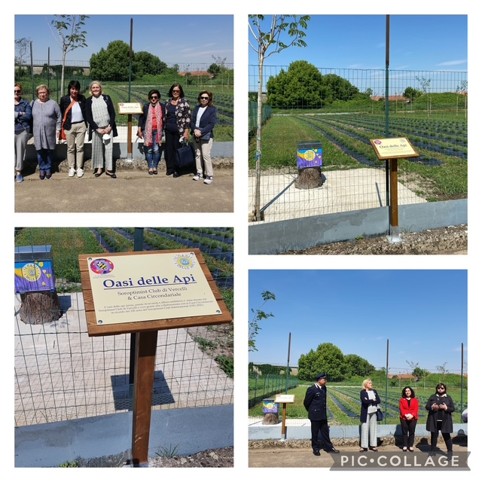
The project closest to my heart is the Oasi delle Api, the Bees’ Oasis, which I inaugurated as Club President in 2021 to mark the Soroptimist International centenary. In the grounds adjacent to Vercelli’s correctional facility, we created a beekeeping sanctuary: 650 lavender plants, 15 honey trees, and a hive entrusted to the care of inmates. Biodiversity, social inclusion and education converged in a single initiative, inmates tended the hive and produced honey, women in detention crafted lavender sachets to sell, and local schoolchildren contributed drawings and stories gathered into an illustrated book. Practical action with a human face.
That same spirit animates SI Sostiene in Carcere, a national project active since 2018, which Vercelli leads as the driving Club in a network of six clubs across north-eastern Piedmont. Over the years, we have offered women in detention a growing range of vocational programmes: basic and advanced sewing, cultivation of medicinal herbs, pastry and icecream making, and most recently, in June 2025, a professional culinary course, Libere in Cucina. Each programme is designed not merely to teach a skill, but to offer a genuine pathway toward independence and social reintegration.
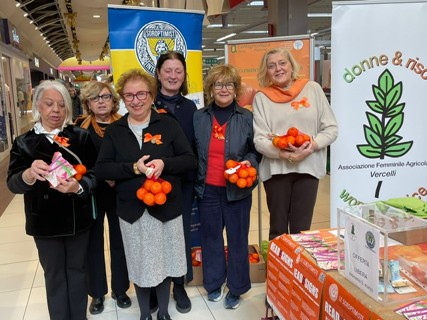
Beyond the correctional facility, the Club maintains strong ties with local institutions. Every year, during the Orange the World campaign, our members join forces with women farmers from Confagricoltura Donna to sell clementines to the public, the proceeds going directly to Vercelli’s anti-violence centre. We work closely with local schools on projects related to education and gender equality, with the hospital, whose doctors have partnered with us for a major conference on gender medicine, and with the Università del Piemonte Orientale, to whose most deserving students we award annual scholarships.
What makes Vercelli special is the conviction that lasting change is built through sustained, concrete commitment to the community, to the institutions we work alongside, and to the women so often forgotten by others.