

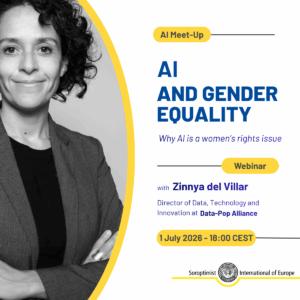
At the opening of the first session of the SIE AI Meet-Up series on 1 July, Keynote speaker Zinnya del Villar, Director of Data, Technology and Innovation at Data-Pop Alliance, set out the premise in a single sentence:
“Gender equality cannot be achieved unless the AI systems shaping our lives are built for equality from the start”.
Not “AI could help”. Not “AI might get better”. Equality depends on it.
For a hundred years, since Soroptimist International was founded in 1921, we have fought the analogue fight for gender equality: for equal pay, equal seats at the table, equal opportunity. That fight is not finished. But a second, faster fight has quietly started inside the systems now deciding who gets that pay, that seat, that opportunity in the first place. If the first fight continues while the second, the one running inside the algorithms, goes unaddressed, one will undo the gains of the other.
What that looks like in practice is already familiar: a CV that never reaches a human recruiter because a filtering algorithm decided it doesn’t match the pattern of a “successful candidate.” A loan application scored against decades of data that quietly favoured men’s financial histories. A promotion an algorithm never flags, because the training data never saw enough women promoted in the first place.
None of this is hypothetical. Across industries, 44% of AI systems show measurable gender bias[1], with consequences reaching into hiring, credit and financial services. In the Netherlands, 74% of men report having AI skills, compared to just 26% of women, a 48-point gap shaping who gets to use these tools with confidence, and who gets left explaining themselves to a system instead[2]. And globally, only 22% of AI professionals globally are women, meaning the perspectives shaping how these systems are built are overwhelmingly not women’s[3].
Taken together, a pattern emerges: the technology quietly deciding who gets hired, promoted, or approved for a loan is being designed by the people least likely to be disadvantaged by it. That is not a coincidence, and it will not correct itself.
What a hundred years of correction looks like
Labour laws once written around a male career. Medical protocols calibrated to male bodies. Financial systems built around a male breadwinner. None of it was designed to exclude women, it simply wasn’t designed with them in mind. Correcting it took a century of unglamorous work, and Soroptimist International has been part of that work throughout.
Now the same pattern is now repeating, at a speed no legislation or workplace policy has ever had to match. AI systems are being built today, by teams still overwhelmingly male, on data that carries forward exactly the inequality a hundred years of advocacy has sought to undo. There is, however, one advantage this time: the window to act is at the design stage, not decades after the fact.
Learning together
For almost two years now, the SIE AI Taskforce has been building a response, not a single project, but a growing body of work across education, research and advocacy.
The Taskforce has run numerous webinars and workshops across Europe on the legal, ethical and practical dimensions of AI, from algorithmic bias to AI regulation. These have fed directly into how we work: position papers and project proposals are now often written with AI support, so that members build fluency, rather than only discussing it.
Putting it in writing
That fluency is backed by substance. The AI Taskforce (with members from Greece, Germany, Türkiye, the Netherlands and Italy), co-authored a position paper for SIE: Artificial Intelligence and Women’s Advocacy: Eliminating Gender Bias through Algorithmic Design. Led by Dr. Catherine Houstis (SI Greece), the paper names five distinct types of gender bias in AI systems, including the allocative bias that decides who gets a loan, a job interview, or a promotion, and proposes a concrete framework, Advocacy-Oriented AI (AO-AI), for building equality into AI systems from the outset. In Germany, Soroptimists produced a position paper addressing deepfakes, a form of AI-enabled abuse that legislation is still struggling to catch up with.
Growing the movement
Alongside this, the SIE AI Ambassador network has grown to more than 125 members across Europe since the SI Congress 2025 in Krakow, women who bring these conversations back to their own clubs and countries, peer to peer.
And on 1 July, SIE launched the first of its AI Meet-Ups, a six-part Rolling Summit Series running through April 2027, each session tackling a different way AI intersects with women’s rights: gender equality, democracy, cyberviolence, work and the economy, health, and education. These are not lecture series. Every Meet-Up is built to end in commitments, not just insights, participants leave having stated what they, personally or organisationally, will do next. The next Meet-Up, on AI and Democracy, takes place in September, and the insights from every session are being gathered into an SIE Position Paper on AI and Women, due for publication in the first half of 2027.
Why this matters now
It would be easy to treat this as a technical problem, best left to engineers and policymakers. SIE’s position is that it is not. Every biased hiring algorithm and every unchecked deepfake decides whose life goes smoothly and whose doesn’t, exactly the kind of decision Soroptimists have organised around for a century.
Zinnya del Villar’s point bears repeating: we cannot wait for AI to be “finished” and then check whether it was fair to women. Design happens now, in rooms most of us will never enter. Soroptimist International of Europe is not willing to fight this fight twice, especially not before the first one is even won. Through the Taskforce, the Ambassador network, the position papers, and every Meet-Up still to come, SIE’s role is to ensure that the question of what these systems mean for women is not an afterthought, but a starting point.
Join us
The next AI Meet-Up takes place in September. Be part of the conversation!
Stay tuned for more information on SIE social media channels.
By Agnes Verhulst, member of the SIE AI Taskforce, SI Kingdom of the Netherlands and of Suriname
[1] https://ssir.org/articles/entry/when_good_algorithms_go_sexist_why_and_how_to_advance_ai_gender_equity
[2] https://www.randstad.nl/over-randstad/pers/persberichten/2024/11/onderzoek-grote-kloof-in-ai-vaardigheden-onder-werkend-nederland
[3] https://www.weforum.org/stories/2022/08/why-we-must-act-now-to-close-the-gender-gap-in-ai/