
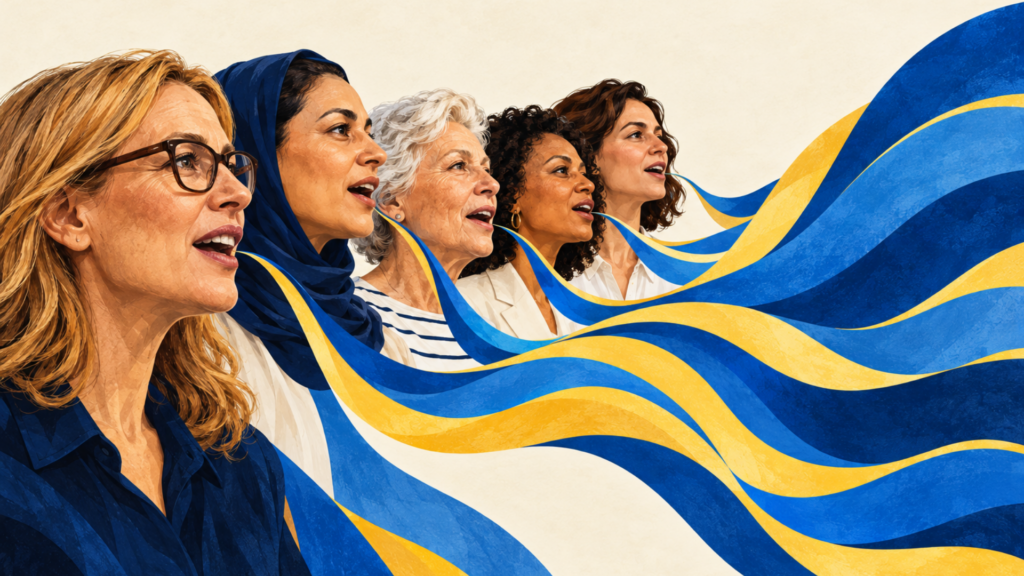
And that voice is needed today more than ever.
Rights we considered secure are being questioned again. Recently, the European Parliament has warned of attacks on women’s rights and a wider democratic backlash. Across the Atlantic, we see how quickly a change in political direction can affect policies, institutions and even the language surrounding equality.
This should make all of us ask: How secure are the rights generations of women fought to achieve? And what is our responsibility when they come under pressure?
Soroptimist is part of civil society. We have professional expertise, international connections and access to institutions and decision-makers. With that comes responsibility – particularly in times such as these.
But where do we begin?
We begin by understanding the issue.
Before deciding what to do, we need to know what is actually happening. Research and reliable data may reveal inequalities. International conventions and monitoring reports show where rights exist and where implementation falls short. Hearings, consultations, specialist organisations and the experiences of women themselves add further perspectives. Within Soroptimist, we also have an extraordinary wealth of professional knowledge.
Bringing that evidence together allows us to ask the right questions: Where is the real problem? Who is affected? What allows it to persist? Who has the power to change it?
Only then should we decide what is needed.
The answer may be a project providing practical support. It may be advocacy: engaging decision-makers, contributing to a consultation, proposing policy change, building a coalition or calling for existing commitments to be honoured. Sometimes more than one action will be needed.
The issue should determine the action.
This also gives us a broader perspective on the impressive work already being done in our Clubs. Projects create tangible impact in women’s lives. They can also generate valuable knowledge. When a project reveals a recurring barrier or a gap between rights on paper and reality, why stop there? The experience can become the starting point for wider change.
And this brings us to the lesson to be learned from the lives of Florence Nightingale and Eleanor Roosevelt: knowledge becomes truly powerful when it is used to create change.
Nightingale reminds us of our responsibility to respond when people need support. Roosevelt – herself a Soroptimist – reminds us of our responsibility to help shape the conditions in which people live. As Chair of the UN Commission on Human Rights and its drafting committee, she played a central role in developing the Universal Declaration of Human Rights.
Our society needs both forms of engagement. What the situation requires should guide what we do.
Women’s rights did not advance because previous generations waited for change. Women brought ideas into public debate, challenged accepted thinking, demanded better laws, and insisted on their implementation.
Our responsibility is to build on the impact we already create – to look further, think critically and recognise where our knowledge and experience can and must contribute to systemic change for the benefit of all women and girls.
This is what Be THE Voice for Women’s Rights is about, an invitation to every Soroptimist to become an agent of change. Because whenever women’s rights are at stake, our collective voice must be heard, and must be impossible to ignore.
Sabine Reimann, SIE President 2026-2027